
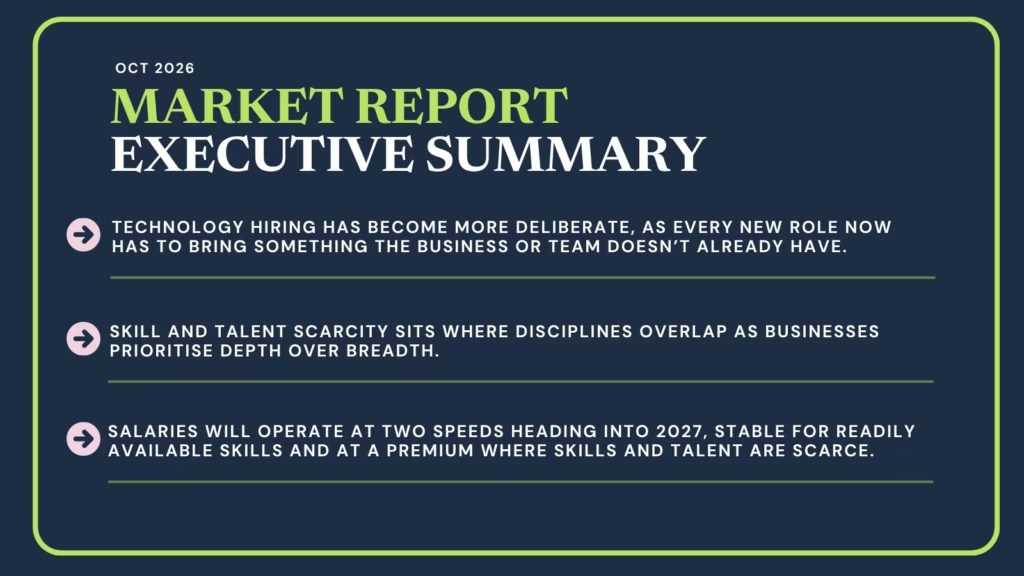
We’ve seen technology hiring become far more deliberate over the past three months. Most noticeably, a drop in demand for generalist, mid-level permanent developers, whilst specialist contractor demand has remained steady.
The market shift is less about reduced hiring numbers and more to do with hiring managers setting a higher bar for any new head count approval.
As hiring managers and HR directors finalise their 2027 budgets, workforce plans are coming under close scrutiny. Every new role now has to answer one simple question: what will this add towards our business goals that we don’t already have in place?
- What we're seeing in the market
In previous years, businesses would hire in volume as they scaled delivery teams throughout the year, where we’re seeing the shift today, there is less need for breadth and more need for leadership and depth of experience.
Businesses are prioritising specialists who can influence architecture and technical direction, beyond just building features and with it, we’ve seen demand strengthen for senior specialists across cloud and platform engineering, DevOps, data engineering, AI and machine learning, cybersecurity and senior software engineers.
While it may be easier to find a mid-level developer than it was a year ago, it’s still hard to find someone with senior specialist experience who can lead a complex, business-critical piece of work. This resulted in a natural split in the market between general capability that’s readily available, and proven senior specialists that remains scarce. It’s a pattern we expect to continue heading into Q1 of 2027.
For contractors, hiring held steady in the last quarter, as investment into short term specialist capability can be tied to a deadline to support a programme or a definitive piece of work. While permanent hires require a different level of conviction and investment, carrying a far bigger commitment to a capability the business wants to retain once the programme is complete.
Heading into 2027, we anticipate seeing hiring managers building permanent teams around leadership, architecture, critical intellectual property and the areas the business needs to grow and own. While continuing to use contractors to drive transformation work, deliver specialist project outcomes and define programmes where the need has a clear end date.
- Where the market is still tight
The hardest roles to fill are increasingly found where disciplines overlap and depth in experience is necessary.
A senior cloud or platform engineer, for example, may need strong AWS or Azure experience, Kubernetes, infrastructure as code, CI/CD, security awareness and credible software-engineering foundations. There are plenty of candidates with part of that profile, but finding a specialist able to operate confidently across the full mix is harder to find. We have noticed a similar pattern in data, AI and cybersecurity.
While many professionals will reference AI experience, hiring managers are focusing on finding someone who has built, deployed, monitored and even improved machine learning systems in production, and they are willing to pay a premium for this expertise.
Cybersecurity on the other hand remains difficult where the requirement extends beyond governance or compliance and into cloud, engineering or application security.
Even senior software-engineering roles, while in demand, the expectation is changing. Hiring managers are increasingly looking for people who can contribute to architecture, system design, cloud decisions and technical strategy, and who can use AI-enabled development tools to improve delivery without compromising quality.
We anticipate more demand across the below roles in the next three to six months:
- Cloud and platform engineering with strong software-engineering depth
- Data and AI capability with live production experience
- Cybersecurity with cloud or engineering expertise
- Senior engineers who can lead architecture and technical decision-making
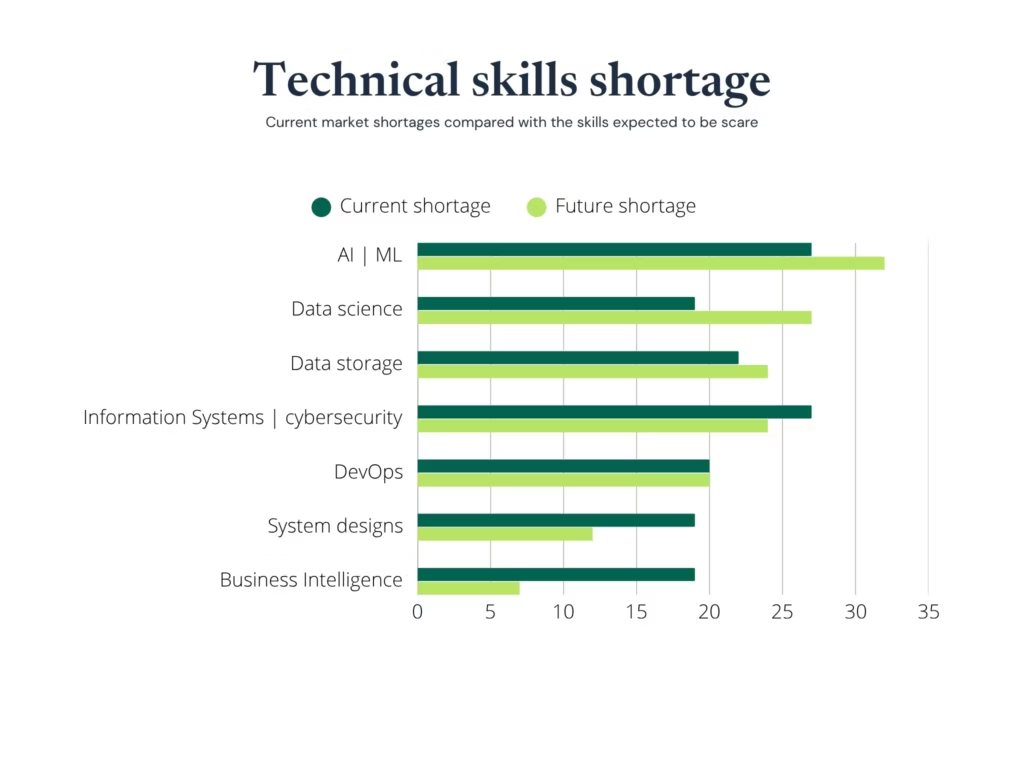
The IITPSA’s 2024 ICT Skills Survey identified AI and machine learning, data science, cybersecurity and DevOps as the areas of greatest shortage, and expected the AI and data science gaps to widen, which we’re now actively seeing play out in the market. These shortages are most visible in experienced people who can work across disciplines and take genuine ownership over the work.
Typically these people are already employed and so are not on the ‘visible’ market, which means a more defined recruitment strategy will be required.
Our view heading into Q1 2027

We expect Q1 2027 to be busier than the final quarter of this year, but as mentioned, far more considered and selective when it comes to recruitment.
Most businesses will continue to keep technology teams lean and where hiring is a possibility it will need to meet a strong commercial case, a transformation priority or a delivery risk that cannot be absorbed by the existing team.
Demand should remain strongest across cloud and platform engineering, data engineering, AI and machine learning, cybersecurity and senior software engineering.
AI will also make a more visible difference to traditional developer hiring. The question for many technology leaders is moving from, ‘how many developers do we need?’ to, ‘what level of engineer do we need now that strong engineers can deliver more?’
For some teams, that may mean fewer junior and mid-level hires, a growing concern for those looking to enter the market and grow their careers. It may also mean far stronger competition for senior engineers who can combine technical depth with judgement, design capability and commercial awareness.
We expect contractor demand to remain strong for the same reason it has this year: specialist capability attached to a defined programme is typically easier to approve than another permanent cost.
On salary, we expect a two-speed market to continue. Salaries will vary widely and will mainly be driven by skill in 2027. Pay is likely to stay stable for easier-to-fill roles, while scarce specialists will continue to command a premium. Contractor rates are likely to follow the same pattern.
- What this means for your 2027 workforce plan?
There are four decisions worth making while budgets are still open.
DECISION 1
Budget for the person you actually want, and need.
A softer market does not mean every role will be cheaper to fill, if the role is critical, set the budget at what the required calibre costs today. Saving R100,000 on a key appointment can easily become months of an empty seat, a delayed programme and a second search. The cost of getting the hire wrong is usually greater than the cost of paying appropriately for the right person.
DECISION 2
Be clear about what you need to own.
Not every new hire needs to sit permanently inside the business. This means you can decide which roles protect your core IP, leadership and technical direction, and which are better brought in for a defined period.
This turns a headcount budget into something more useful, a capability plan. Take the time to map out various scenarios and ensure your plan has flexibility for whichever way the market might swing and what the business will need to retain as a result.
DECISION 3
Start before the need becomes urgent.
The strongest people in scarce disciplines are unlikely to be available immediately, so take the time to be clear about what or who you are looking for in advance and more importantly how you will attract them.
If you know you will need a particular capability in 2027, now is the time to understand the likely talent pool, salary expectations, availability and how you will position the opportunity. Waiting until a delivery date for a scarce skill, places you in a position of having to hire under pressure, which typically reduces your options fairly quickly.
DECISION 4
Budget for speed as part of the offer.
When several businesses are pursuing the same person, a slow process becomes a competitive disadvantage.
The business that is clear on the brief, moves quickly and gives candidates confidence in the opportunity will have a meaningful advantage. A lengthy process costs you access to the people you most want to hire.
If you are setting your 2027 workforce plan and want an honest market-led view of where you might be exposed or how best to acquire the people and capability you’re looking for, we’d love to connect.